
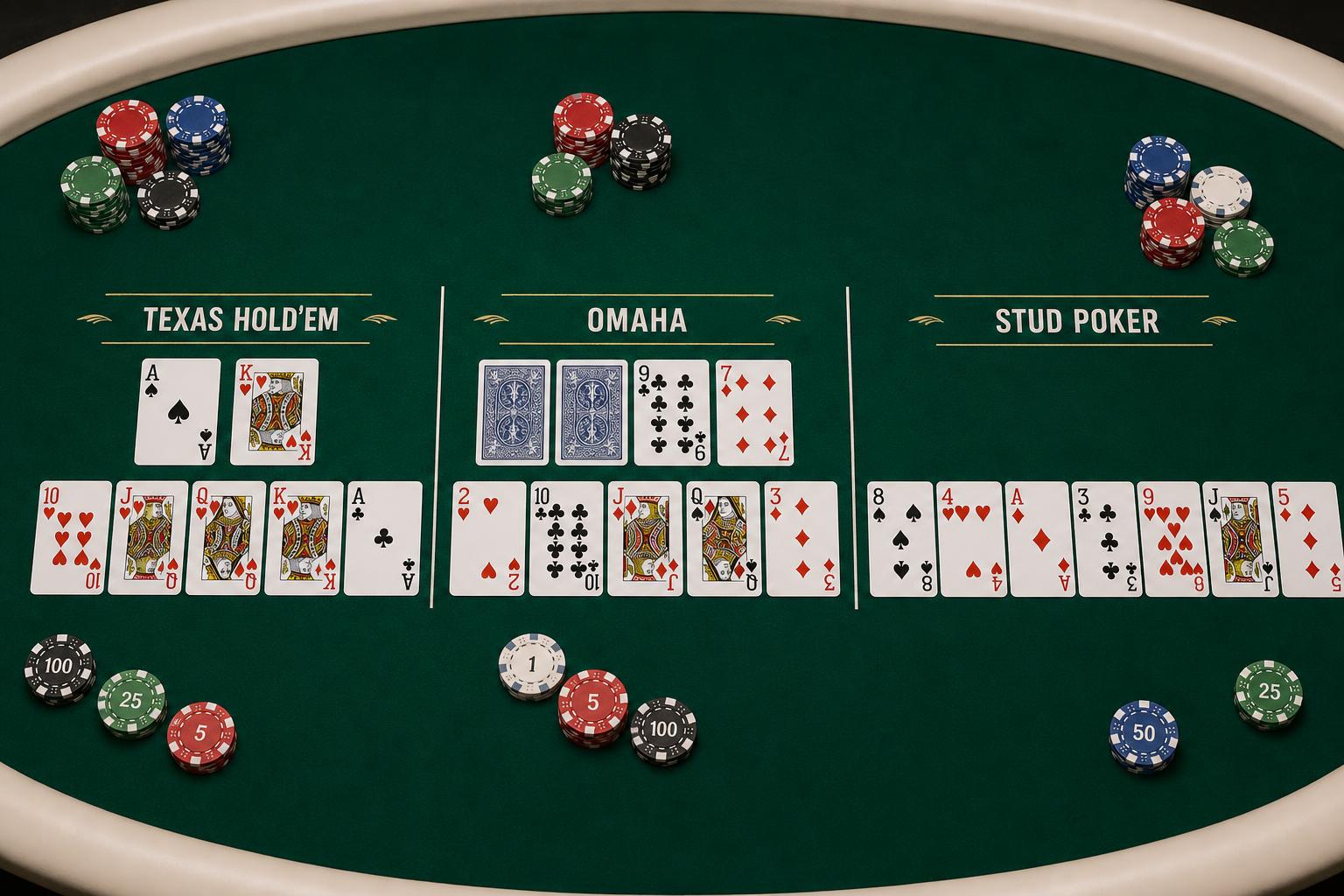
Texas Hold'em — the world's game
Every player receives two hole cards. Five community cards are dealt across three rounds: three on the flop, one on the turn, one on the river. You make the best five-card hand using any combination of your two hole cards and the five community cards — including all five community cards ("playing the board").
Why it dominates: the two-card start is easy for beginners, and the shared community cards create dramatic swings that television loves. Hand equities run closer than any other variant, which means small edges compound into big long-term wins for skilled players.
Pot-Limit Omaha (PLO) — the action game
Each player receives four hole cards. The board is dealt the same as Hold'em, but you must use exactly two of your hole cards and exactly three from the board. That one rule changes everything.
With four hole cards, every player has six two-card combinations to draw from, so hand values run much closer. The nuts change street by street; two pair is often a garbage hand; overpairs are rarely worth stacking off. Pot-Limit betting keeps the pots controlled — nobody can shove all-in preflop, which forces skilled post-flop play.
Omaha Hi-Lo (Omaha 8 or Better)
Same four-card deal as PLO, but the pot is split between the best high hand and the best qualifying low hand (five cards 8 or lower, no pairs). If nobody qualifies for a low, the high hand scoops the whole pot.
The strategic wrinkle: hands that can win both halves — like A-2-3-K double-suited — are massively more valuable than hands that can only win one half. It's a technical game favored by mixed-game specialists.
7-Card Stud — the classic
No community cards. Each player receives seven cards over the course of the hand — three private, four face-up — and makes the best five-card hand from those seven. Betting takes place after each new card.
Because up to 56% of an opponent's cards are visible, memory and observation matter as much as math. Track which cards are exposed on other players' boards and you know exactly which draws are dead. This is the variant where Advantage Players' card-tracking feature really shines — one tap greys out every card you've seen so the equity engine only counts live outs.
Short Deck (6+ Hold'em)
Texas Hold'em played with a 36-card deck: twos through fives are removed. This is the "36" preset in Advantage Players. Because there are fewer low cards, flushes become rarer than full houses (so flushes are re-ranked abovefull houses in most rule sets), and straights hit far more often. Equities run much closer, which produces massive pots and swingy sessions.
Head-to-head at a glance
- Easiest to learn: Texas Hold'em
- Highest variance: Short Deck > Pot-Limit Omaha
- Most technical: Omaha Hi-Lo
- Best test of memory: 7-Card Stud
- Biggest available prize pools: Texas Hold'em (still, by a mile)
Which one should you play?
If you're new, start with Texas Hold'em — the fields are the biggest, the resources are endless, and Advantage Players' equity engine will accelerate your learning. If you already crush low-stakes Hold'em and are looking for the game with the softest fields relative to skill required, try Pot-Limit Omaha. If you love a game that rewards patience and observation, sit down at a 7-Card Stud table and enjoy how few people still know how to play it well.