Royal Flush
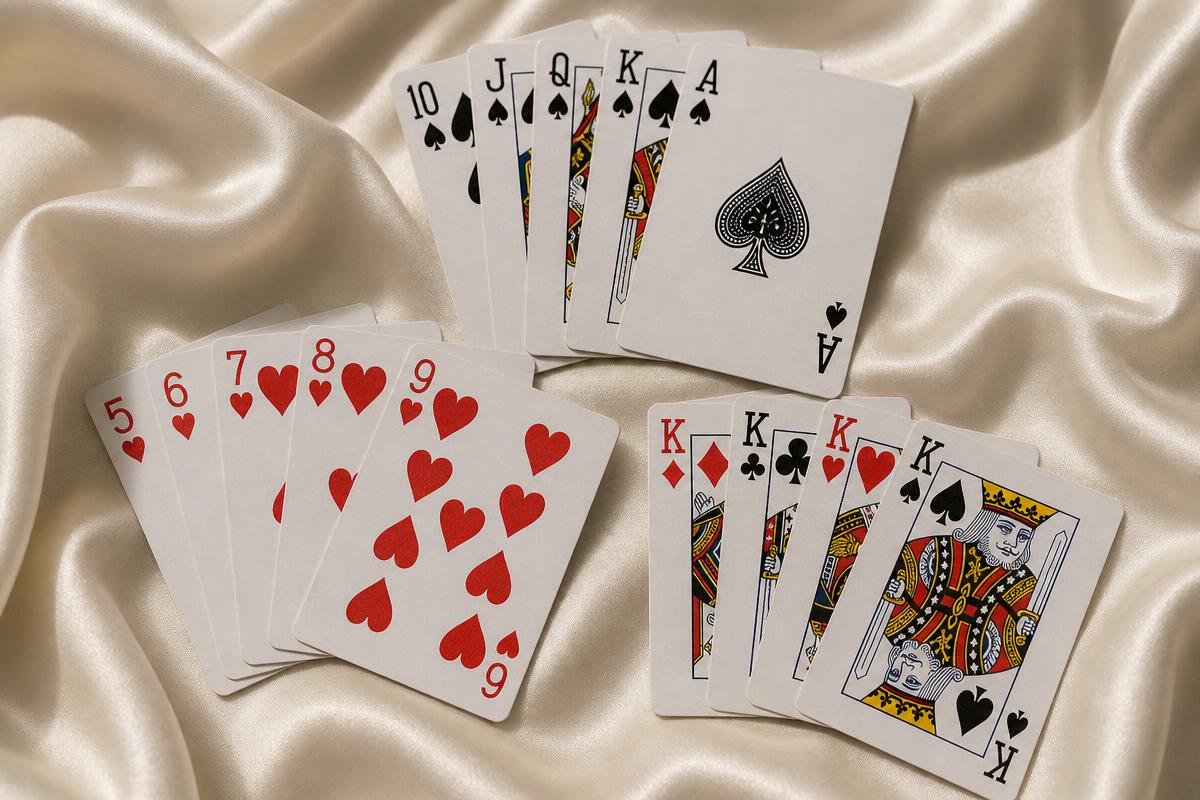
The rarest hand in poker: A-K-Q-J-10, all of the same suit. The probability of being dealt a royal flush in five cards is 1 in 649,740. If you ever hit one at a real casino, ask the pit boss about the promotional bonus — many rooms pay four or five figures for it.
Straight Flush
Five consecutive cards of the same suit — for example 9♠ 8♠ 7♠ 6♠ 5♠. Beaten only by a higher straight flush or a royal flush. When you make one on the river against an opponent holding a big overpair, the pot tends to be enormous.
Four of a Kind
Four cards of matching rank plus any fifth card. K♥ K♦ K♣ K♠ 3♥ is "quad kings". Almost impossible to fold once you have it, and rightfully so — the odds against an opponent holding a straight flush at the same time are astronomical.
Full House
Three of a kind combined with a pair — for example Q♥ Q♣ Q♦ 7♠ 7♥ ("queens full of sevens"). The strength of a full house is decided first by the trips (the threes), then by the pair. Kings full always beats queens full.
Flush
Any five cards of the same suit — for example A♣ J♣ 8♣ 5♣ 2♣. The highest card in the flush wins ties: an ace-high flush beats a king-high flush, and so on.
Straight
Five consecutive cards of any suits — 10♠ 9♦ 8♣ 7♥ 6♣. Aces can play both high (10-J-Q-K-A) and low (A-2-3-4-5, called the "wheel"). Straights that use the ace as low are the weakest possible straight.
Three of a Kind
Three cards of matching rank plus two unrelated cards — J♥ J♣ J♦ 4♠ 9♥. In Hold'em, three of a kind can come two ways: as a "set" (a pocket pair matching a board card, hard to spot) or as "trips" (one hole card matching a paired board, easy to spot). Sets earn more money.
Two Pair
Two different pairs plus a fifth card — 10♥ 10♣ 4♦ 4♠ K♥. Ties are broken by the highest pair, then the lower pair, then the kicker.
One Pair
A single pair with three unrelated cards — 7♦ 7♠ Q♥ 5♣ 2♦. The most common made hand at showdown in Hold'em. Big pairs (10-10 and up) usually win multi-way pots without improvement.
High Card
No pair, no straight, no flush — just the highest card in your hand. Ace-high wins more small pots than beginners expect, especially against loose opponents who missed their draws.
Reading combinations at the table
- Always identify the current best possible hand ("the nuts") given the board.
- Compare your hand to the nuts, not just to what you think your opponent might have.
- Two pair on a coordinated board is a bluff-catcher, not a monster.
- A set on a paired board can lose to a full house — proceed carefully.
Advantage Players surfaces the current best five-card hand your cards make in the tool's info panel, so you never have to squint at the board wondering whether that innocent-looking 8 gives you a straight. Combined with the live equity readout it turns hand-reading from an art into an audited skill.